THC vs CBD — What's the Difference? Complete Australian Guide
THC vs CBD is one of the most searched cannabis questions in Australia — and with good reason. Both compounds come from the same plant, yet they produce completely different effects and sit under completely different legal frameworks here. This guide explains the science, the effects, the Australian legal reality, and how to choose between them.
What Are THC and CBD?
THC (tetrahydrocannabinol) and CBD (cannabidiol) are both cannabinoids — naturally occurring chemical compounds found in the cannabis plant. The cannabis plant contains over 100 known cannabinoids, but THC and CBD are by far the most abundant and the most studied.
Both compounds interact with the body's endocannabinoid system (ECS) — a network of receptors found throughout the brain, central nervous system, immune system, and organs. The ECS regulates everything from mood and pain perception to appetite, sleep, and immune response.
Despite sharing a similar molecular structure (they're chemical isomers — same atoms, different arrangement), THC and CBD interact with ECS receptors in fundamentally different ways, which is why their effects are so distinct.
THC vs CBD — At a Glance
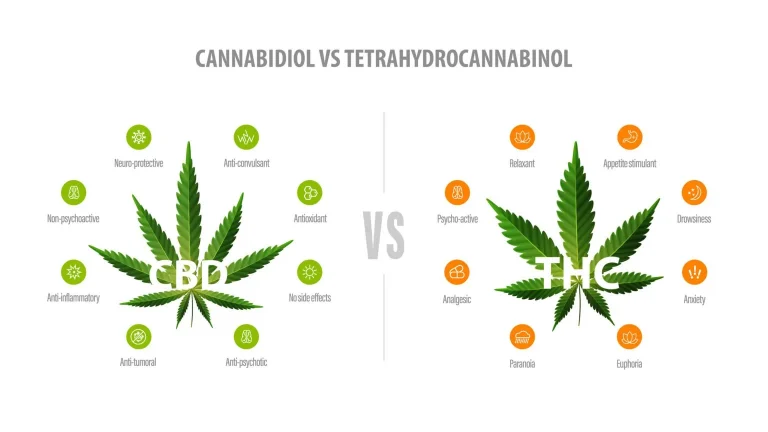
- Psychoactive — produces a "high"
- Activates CB1 brain receptors directly
- Euphoria, relaxation, altered perception
- Can cause anxiety at high doses
- Illegal outside a medical prescription in every state/territory except the ACT's limited framework
- Found in cannabis flower, vapes, edibles, pre-rolls
- Triggers Australia's zero-tolerance roadside drug tests
- Stronger appetite stimulation
- Non-psychoactive — no "high"
- Indirect/modulating ECS effect
- Calm, relaxation without intoxication
- Generally well tolerated
- Regulated as a medicine in Australia — not freely available like in the UK/US
- Found in oils, capsules, gummies, creams (prescription-based in AU)
- Pure CBD isolate typically not tested for*
- Mild anti-inflammatory properties
*Full-spectrum CBD products may contain trace THC that could trigger some tests. See FAQ below.
Full Comparison Table: THC vs CBD
| Property | THC | CBD |
|---|---|---|
| Full name | Tetrahydrocannabinol | Cannabidiol |
| Psychoactive? | Yes — produces euphoric "high" | No — completely non-intoxicating |
| Receptor binding | Strong CB1 agonist (brain receptors) | Indirect — modulates CB1 & CB2 |
| Australian legal status | Illegal outside prescription (all states except ACT limit) | Scheduled medicine — prescription is the practical route |
| Primary effects | Euphoria, relaxation, altered time perception, hunger | Calm, reduced tension, mild anti-inflammatory |
| Anxiety risk | Can increase anxiety at high doses | May help reduce anxiety for some users |
| Appetite | Strong stimulant ("munchies") | Little to no effect |
| Sleep | Indica-dominant THC strains aid sleep | Some users report improved sleep |
| Pain relief | Strong analgesic properties | Anti-inflammatory; milder analgesic |
| Roadside drug test risk | Yes — zero tolerance, any detectable amount | Low for isolate; full-spectrum products carry the same zero-tolerance risk as THC |
| Common product forms | Flower, vapes, pre-rolls, edibles, hash | Tinctures, capsules, topicals (prescription route) |
| Onset (inhaled) | 2-10 minutes | 2-10 minutes |
| Duration (inhaled) | 1-3 hours | 1-2 hours (subtler) |
| Onset (oral/edibles) | 30-90 minutes | 30-90 minutes |
| Duration (oral/edibles) | 4-8 hours | 4-6 hours |
How Does THC Work in the Body?
THC is a partial agonist at CB1 receptors, which are concentrated in the brain — particularly in areas governing pleasure, memory, coordination, and time perception. When THC binds to these receptors, it mimics the body's naturally produced endocannabinoid anandamide (often called the "bliss molecule"), but at a far greater intensity and duration.
This is why THC produces such a distinctive set of effects: euphoria and elevated mood as dopamine release increases; altered time perception where minutes can feel like hours; enhanced sensory experience where music sounds richer and food tastes better; relaxation and sedation, especially with indica-dominant strains; increased appetite via hypothalamus activation (the famous "munchies"); and short-term memory effects, as THC temporarily impairs working memory at high doses.
THC percentage in a product gives you a guide to potency. A beginner-friendly strain might sit at 15-18% THC, while premium strains often reach 25-30%+. To learn more, read our full guide on what THC is and how it works.
How Does CBD Work in the Body?
CBD works very differently. Rather than directly activating CB1 receptors, CBD has a low binding affinity for both CB1 and CB2 receptors. Instead, it acts as a negative allosteric modulator of CB1 — meaning it can actually change the shape of the receptor so that THC binds less effectively, moderating THC's psychoactive impact.
CBD also interacts with a wide range of other receptors and systems: serotonin receptors (5-HT1A), associated with CBD's anxiolytic and anti-depressant properties; TRPV1 receptors, involved in pain and inflammation regulation; GPR55 receptors, linked to bone density and inflammation; and adenosine receptors, influencing sleep and inflammation.
This broad, multi-receptor activity is why CBD is associated with such a wide range of reported benefits — without any intoxication. Many users describe the sensation as nothing in particular — just the absence of stress, or feeling more settled and comfortable.
Australian Legal Status: THC vs CBD — The Real Picture
This is perhaps the most practically important — and most misunderstood — difference for Australian buyers, and it looks genuinely different from what a UK or US reader might expect.
| Compound | Australian Legal Status | Key Conditions |
|---|---|---|
| THC | Illegal outside medical prescription | Possession, production, and supply are offences in every state/territory except the ACT's limited personal decriminalisation framework. Medical cannabis is available via AHPRA-registered doctor prescription. |
| CBD | Regulated as a medicine | High-purity CBD requires a Schedule 4 prescription. A Schedule 3 pharmacist-only pathway exists in law since 2021 but has zero approved products as of 2026 — genuine OTC CBD does not yet exist in Australian pharmacies. |
| Full-Spectrum/Grey-Market CBD | Not TGA-approved medicine | Products sold online as "CBD oil" or "CBD gummies" outside a pharmacy are grey-market, not lawfully supplied as medicine — distinct from a genuine TGA-regulated product. |
For the full breakdown of cannabis law in Australia, read our detailed guide: Is Cannabis Legal in Australia? and our guide to legal cannabis access in Australia.
Drug Driving — Australia's Zero-Tolerance Rules
This is a point that genuinely surprises many Australians, including regular CBD users: unlike alcohol, there is no minimum threshold for THC in Australian roadside drug testing. Every state and territory conducts random roadside oral fluid (saliva) testing, and any detectable amount of THC is an offence — regardless of whether you feel impaired, and regardless of whether the THC came from recreational cannabis, a full-spectrum CBD product, or a medical prescription.
This matters directly for the THC vs CBD decision: a "CBD" tincture or gummy that is actually full-spectrum (containing trace THC) can trigger a positive roadside test in exactly the same way as THC flower. If you plan to drive and want zero risk, the product must be a genuine broad-spectrum or isolate formulation with independently verified zero THC content — not simply labelled "CBD-dominant."
The Entourage Effect — Why THC and CBD Work Better Together
Here's something many buyers don't realise: THC and CBD don't just coexist — they actively modify each other's effects. This phenomenon is known as the entourage effect.
Research suggests that whole-plant cannabis products (containing a range of cannabinoids and terpenes together) produce more nuanced, balanced effects than isolated compounds alone. Key interactions include: CBD reduces THC-induced anxiety, as CBD's effect on CB1 receptors can smooth out the edges of a strong THC experience, reducing paranoia and racing thoughts; CBD may extend THC's duration, with some evidence suggesting CBD slows THC breakdown in the body; and terpenes amplify both, as compounds like myrcene, limonene, and linalool interact with both cannabinoids to shape the final experience.
This is why experienced users often prefer strains or products with a balanced THC:CBD ratio over high-THC-only products — and why full-spectrum CBD products are considered more effective than CBD isolate by many users, even though (as covered above) this carries roadside testing implications in Australia.
THC:CBD Ratios — Real Products from the Leaflybuds Range
| Ratio Type | Typical Experience | Best For | Real Example |
|---|---|---|---|
| 1:1 (equal THC & CBD) | Balanced, manageable high with reduced anxiety | Beginners, anxiety-prone users, daytime use | Sleep CBN Tincture (1:1 CBN:THC) |
| High THC, low CBD | Strong, intense psychoactive experience | Experienced users, high tolerance | Permanent Marker flower, 25-35% THC |
| 18:1 to 20:1 (CBD-dominant) | Very mild high, pronounced relaxation | Low-tolerance and anxiety-prone users | 20:1 Relief AM/PM Tinctures; CBD Relief 18:1 Tart Cherry Gummies |
| Multi-cannabinoid blend | Complex, calming, minimal psychoactivity | Wellness-focused users | Tranquility Sublingual Spray (1:1:1:2 blend) |
| CBD only (isolate/near-zero THC) | No high, calm & settled feeling | Non-psychoactive wellness use, roadside test caution | Full Spectrum CBD Tincture, Double Strength CBD Elixir |
See our full Cannabis Wellness Australia Directory for condition-by-condition product recommendations across this range.
Effects Comparison: What Does Each Feel Like?
What THC Feels Like
The effects of THC vary by strain type, dosage, and individual tolerance. Sativa-dominant THC strains are uplifting, cerebral, and energetic — good for creative tasks and social settings; see our Best Sativa Strains Australia guide. Indica-dominant THC strains are deeply relaxing, body-heavy, and sleep-inducing — good for evenings and rest; see our Best Indica Strains Australia guide. Hybrid strains blend both and can lean either direction.
At lower doses, THC typically feels pleasant and manageable. At higher doses — especially with edibles — it can feel overwhelming. Always start low. Read our Cannabis Edibles Australia Dosage Guide for safe dosing guidance.
What CBD Feels Like
CBD is far more subtle. Many users describe it as a gentle unwinding of tension, feeling "normal but calmer," reduced mental noise or overthinking, and a slight reduction in physical discomfort. There is no intoxication, no euphoria, and no impairment. First-time CBD users are often surprised by how subtle it is — or even feel nothing at first, particularly with lower-dose products.
THC vs CBD for Common Uses
| Use Case | THC | CBD | Recommended Approach |
|---|---|---|---|
| Recreational relaxation | ✅ Excellent | ➖ Mild | THC — indica strain or hybrid |
| Sleep support | ✅ Strong | ✅ Moderate | THC indica or balanced ratio |
| Anxiety relief | ⚠️ Risk of worsening | ✅ Promising | CBD or low-THC balanced product |
| Pain relief | ✅ Strong | ✅ Moderate | Combination (full-spectrum) often best |
| Creativity/focus | ✅ Sativa strains | ➖ Minimal | Low-dose THC sativa |
| Driving/daytime function | ❌ Impairs, illegal to drive after | ✅ Isolate only — verify COA | CBD isolate with verified 0% THC only |
| Nausea/appetite | ✅ Very effective | ➖ Weaker | THC |
| Roadside test sensitivity | ❌ Will test positive | ✅ Safe (verified isolate) / ⚠️ (full-spectrum) | Verified CBD isolate only |
How to Choose: THC, CBD, or Both?
Your choice should be guided by three questions: Do you want to feel high? If yes, THC products; if no, CBD only. What are you looking to achieve — relaxation, sleep, creativity, pain relief, or simply wellness without intoxication? What is your tolerance and experience level — beginners should start with low-THC or balanced products.
Common Myths About THC and CBD
"More THC always means better" — Not necessarily. Terpene profile, growing method, and cure all affect quality and experience. A 20% strain with exceptional terpenes can outperform a 30% mediocre one.
"CBD has no effect at all" — CBD is genuinely active in the body — it just doesn't produce a high. Many users notice real differences in tension, sleep quality, and comfort.
"CBD cancels out THC completely" — CBD moderates THC; it doesn't eliminate it. You'll still feel high; it may just be smoother and less anxious.
"THC is only for getting high" — THC has genuine analgesic, anti-nausea, and sleep-promoting properties recognised in medical cannabis research and reflected in Australia's TGA-approved products (Sativex, Epidyolex).
"CBD is completely risk-free" — CBD is generally very well-tolerated, but it does interact with some medications, particularly blood thinners. Consult a doctor if you take prescription medication.
"You can't get in trouble driving after CBD" — If the product is full-spectrum with any detectable THC, you can still fail Australia's zero-tolerance roadside drug test, as covered above.
"You can't overdose on either" — A fatal overdose of cannabis is not documented. However, taking too much THC — especially in edible form — can cause extremely unpleasant anxiety, paranoia, and physical discomfort. Always dose responsibly.
Ready to Explore THC Products?
Leaflybuds stocks 150+ premium, lab-tested products — from high-THC flower and vapes to pre-rolls, edibles, and concentrates. Same-day dispatch before 2pm via Australia Post Express Tracked.
Browse All Products →
Lab-tested Cali genetics, same-day dispatch before 2pm, Australia Post Express Tracked. $150 AUD minimum order.
Shop Leaflybuds Now →