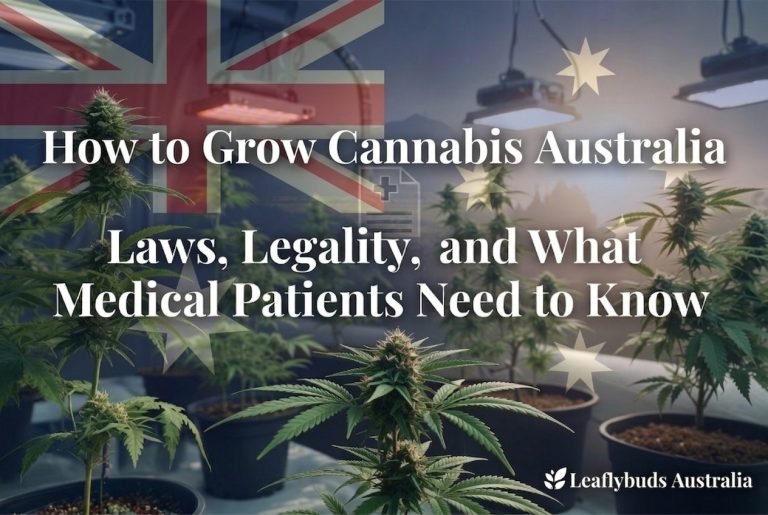
How to Grow Cannabis in Australia — Laws, Legality, and What Medical Patients Need to Know
Cannabis cultivation law in Australia is genuinely more complex than a single national rule — it varies significantly by state and territory, with one jurisdiction operating under a completely different framework from the rest. This guide provides a comprehensive, factually accurate overview of Australian cannabis cultivation law, medical patient rights, and industrial hemp licensing.
Cannabis Cultivation Law in Australia — The Current Framework
Unlike the UK's single national Misuse of Drugs Act, Australia does not have one uniform cultivation law — each state and territory has its own drug legislation, and the position genuinely differs depending on where you are. The one constant is that recreational cannabis cultivation is a criminal offence everywhere in Australia except the Australian Capital Territory, which operates a limited personal decriminalisation framework covering both possession and home cultivation.
State and Territory Legislation — What It Actually Says
Cannabis cultivation offences sit in each jurisdiction's own drugs legislation — the Drug Misuse and Trafficking Act 1985 in NSW, the Drugs, Poisons and Controlled Substances Act 1981 in Victoria, the Drugs Misuse Act 1986 in Queensland, and equivalent Acts elsewhere. All of them make it an offence to cultivate, or knowingly take part in cultivating, a prohibited plant — cannabis — without an appropriate licence or authority. Penalties escalate sharply based on the number of plants involved, whether cultivation was for a commercial purpose, and whether "enhanced indoor means" (hydroponics, artificial lighting) were used, which typically lowers the plant-count thresholds that trigger more serious charges.
Cannabis Cultivation — The Specific Legal Position
Cultivation is treated as an offence regardless of the grower's purpose in every state and territory outside the ACT — personal use is not a defence to the charge itself, though it is a significant factor in sentencing. Even a single seedling technically constitutes an offence in states without a personal cultivation exemption. Aggravating factors that meaningfully affect sentencing include the scale of the operation, evidence of commercial intent, use of hydroponic or enhanced indoor growing methods, and cultivation on rented premises.
Industrial Hemp — The Legal Exception Nationwide
Every Australian state and territory operates an industrial hemp licensing scheme — the Hemp Industry Act 2008 in NSW, the Industrial Hemp Act 2004 in WA, the Industrial Hemp Act 2017 in SA, the Industrial Hemp Act 2015 in Tasmania, equivalent provisions within Victoria's and Queensland's drugs legislation, and the Hemp Fibre Industry Facilitation Act 2004 in the ACT. Industrial hemp is defined as cannabis with no more than 1% THC in the leaves and flowering heads in most states (0.35% in Victoria and Tasmania), grown from certified low-THC seed. Licences require police/criminal history checks, site security arrangements, and regular crop THC testing by an accredited laboratory. These licences are for fibre, seed, and non-therapeutic industrial uses only — they do not permit cultivation of high-THC cannabis varieties under any circumstances, and cultivating without a licence remains a criminal offence even if the crop happens to test under the THC threshold.
Medical Cannabis in Australia — The Legal Framework Since 2016
The most significant change to Australian cannabis law in decades occurred with the Narcotic Drugs Amendment Act 2016, which established a nationally consistent framework for legal medicinal cannabis access for the first time — cannabis was rescheduled from Schedule 9 (prohibited) to Schedule 8 (controlled, available on prescription) in November 2016.
Who Can Be Prescribed Medical Cannabis
Medical cannabis can be prescribed by an AHPRA-registered doctor, typically operating under Authorised Prescriber status or applying through the TGA's Special Access Scheme Category B for each patient. Only two products — Sativex (MS spasticity) and Epidyolex (Dravet syndrome, PBS-listed) — are actually TGA-approved; the overwhelming majority of prescriptions are for "unapproved" products accessed via SAS-B or AP. Conditions most commonly treated include chronic pain, anxiety, PTSD, insomnia, fibromyalgia, and cancer-related symptoms, as covered in depth in our medical cannabis clinics guide.
Private Telehealth Clinics — How They Work
Private medical cannabis telehealth clinics have grown substantially in Australia since 2016. Clinics including Alternaleaf, Medio, Polln, Australian Access Clinics, and Cannalink Clinic provide specialist consultations, predominantly online, and can prescribe medical cannabis to qualifying patients. The process typically involves an online eligibility questionnaire, a nurse or doctor consultation, a review of medical history and previous treatments, and — if clinically appropriate — a prescription dispensed through a partner pharmacy. Almost none of this is PBS-subsidised, and annual costs commonly range from $1,285 to $5,400+ as covered in our cannabis prices guide.
Can Medical Cannabis Patients Grow Their Own?
No, in almost every circumstance. A medical cannabis prescription in Australia authorises the patient to possess and use the specific prescribed product dispensed by a pharmacy — it does not create any general right to cultivate cannabis plants. Outside the ACT, cultivating cannabis remains a criminal offence regardless of the grower's medical status, and no state currently recognises a medical cultivation exemption tied specifically to a prescription. Even in the ACT, the personal cultivation allowance (2 plants per adult, 4 per household) is a general adult entitlement available to any resident — not a medical-specific right, and not something a prescription changes or expands.
The ACT — Australia's One Genuine Cultivation Exception
Since January 2020, the Australian Capital Territory has operated under a framework that genuinely differs from the rest of the country. Adults in the ACT may possess up to 50 grams of dried cannabis and cultivate up to 2 plants per person (4 plants per household maximum, regardless of how many adults live there) for personal use at a private residence.
No other Australian state or territory has adopted an equivalent personal cultivation allowance. South Australia and the Northern Territory operate civil expiation notice (on-the-spot fine) schemes for minor possession, but neither extends this to cultivation — growing cannabis remains a criminal offence in both.
Cultivation Penalties — What the Law Actually Provides
Penalties vary meaningfully by state and by the scale of cultivation. This table summarises the general pattern in the two most populous states, plus the ACT exception, as a representative illustration — always check current legislation for your specific state or territory.
| Jurisdiction | Small/Personal Scale | Commercial/Large Scale |
|---|---|---|
| New South Wales | Up to 2 years (Local Court, small quantity) | Up to 15-24 years depending on quantity and aggravating factors |
| Victoria | Up to 1 year if non-trafficking purpose proven on the balance of probabilities | Up to 15 years where trafficking purpose is not excluded, or for commercial quantities |
| ACT (private residence, within limits) | Not a criminal offence — up to 2 plants/person, 4/household | Still illegal beyond the personal-use limits or for supply |
| Queensland, WA, SA, Tasmania, NT | Criminal offence; penalties and cautioning schemes vary by state | Generally serious indictable offences with lengthy maximum penalties |
How the Law Is Actually Enforced — Realistic Prosecution Risk
The gap between statutory maximum penalties and how cannabis law is actually enforced varies by state, but a consistent pattern holds across Australia: cultivation is treated considerably more seriously than simple possession, everywhere.
Personal Possession — The Realistic Position
Most Australian states operate some form of cautioning or diversion scheme for first-time, small-quantity possession — South Australia and the Northern Territory use civil expiation notice (on-the-spot fine) systems, NSW has a formal Cannabis Cautioning Scheme for small quantities, and other states use police discretion and formal cautioning programs. These schemes generally do not extend to cultivation, and eligibility for a caution is not a right — it is discretionary, varies by state, and does not apply to repeat offenders or anyone with a relevant prior record.
Cultivation — Sentencing Reality
Cultivation is prosecuted considerably more seriously than possession in every state. A small domestic grow with clear evidence of personal use only is more likely to attract a community-based order or suspended sentence for a genuine first offence in most states, but this is a matter of sentencing discretion, not a guaranteed outcome — imprisonment remains a real possibility even for a first offence given how seriously courts treat cultivation offences generally. Larger grows, evidence of commercial activity, organised operation, and repeat offending all escalate the likely sentence toward each jurisdiction's statutory maximum. Police forces across Australia execute warrants for cannabis grow operations detected through elevated electricity consumption, thermal imaging, and intelligence — rented properties used for cultivation expose both the grower and potentially the landlord to legal consequences.
Drug Driving — A Separate and Serious Risk
Every Australian state and territory applies zero-tolerance roadside drug testing for THC via oral fluid (saliva) testing — any detectable amount is an offence regardless of subjective impairment, with no minimum threshold the way there is for alcohol. This applies whether the cannabis was legally grown in the ACT or otherwise sourced, and detection can persist for many hours after any effects have worn off, as covered in our edibles dosage guide.
Where Australian Cannabis Law Is Heading
The debate around cannabis law reform in Australia has become more prominent in recent years, though the trajectory of actual change remains gradual.
The 2024 Federal Vote
The Legalising Cannabis Bill 2023, introduced by Australian Greens Senator David Shoebridge, would have permitted adults to grow up to six plants per household nationally, share homegrown cannabis, and possess up to 50 grams. The Senate voted on the bill on 27 November 2024 — the first time Federal Parliament had voted on recreational cannabis legalisation — and it was defeated 13 to 24, with both the Coalition and Labor voting against it. Public support for legalisation has grown regardless, with national survey data now showing more Australians in favour of legalisation than opposed.
The Schedule 3 CBD Bottleneck
A genuine near-term development worth watching is whether any manufacturer successfully registers a low-dose CBD product for pharmacist-only (Schedule 3) sale — a pathway that has existed in law since 2021 but has never actually been used by an approved product, as covered in our legal cannabis in Australia guide.
What Remains Unchanged and What to Watch
Regardless of political debate, the current legal position is clear — cultivation remains a criminal offence in every state and territory except the ACT's limited personal framework. The most likely near-term developments are further state-based decriminalisation or expanded medical access rather than a national legal cultivation or recreational framework. Anyone growing cannabis outside the ACT's specific allowance should understand that the current law applies fully, and that enforcement, while discretionary for personal possession in some states, remains a genuine legal risk for cultivation specifically.
Browse All Leaflybuds Products
Five categories, all independently lab-tested, all available for same-day dispatch Monday–Friday before 2pm.
Skip the Grow — Premium Genetics Delivered Same Day
Lab-tested Cali genetics, same-day dispatch before 2pm, Australia Post Express Tracked. $150 AUD minimum order.
Shop THC Flower Australia →