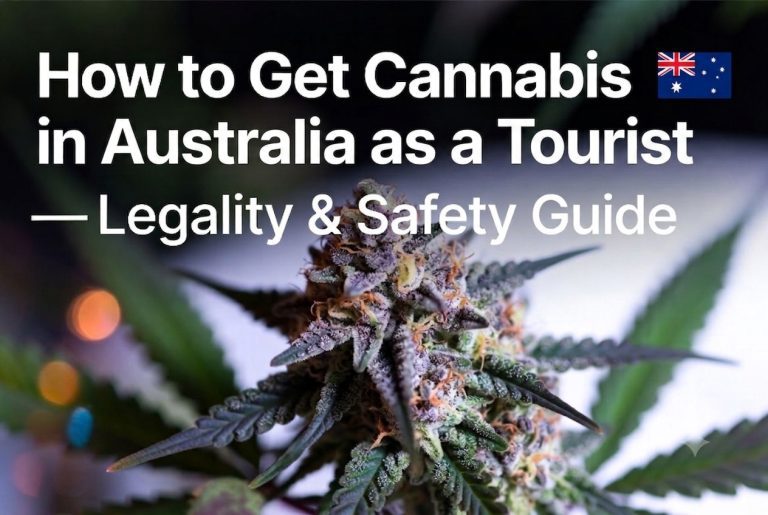
How to Get Cannabis in Australia as a Tourist
The complete honest guide for international visitors — Australian cannabis laws, what tourists from legal countries need to know, delivery options, police enforcement, and how to stay safe
- Australian cannabis laws — what every tourist must know first
- Tourists from legal countries — your home laws don't apply here
- Can you bring cannabis into Australia?
- Medical cannabis tourists — carrying your prescription
- The CBD reality tourists need to know
- Cannabis delivery for tourists — hotels, Airbnbs and beyond
- Where NOT to buy cannabis as a tourist
- Police enforcement — what tourists actually experience
- The ACT decriminalisation framework — what tourists should know
- Australia vs your home country — full legal comparison table
- The future of cannabis in Australia — what tourists should watch
- Frequently asked questions
Australian Cannabis Laws — What Every Tourist Must Know First
Before anything else, every tourist visiting Australia needs to understand one fundamental fact: recreational cannabis is illegal to possess, cultivate, or supply in every Australian state and territory except the Australian Capital Territory, which has a limited personal decriminalisation framework. There are no general tourist exemptions, and the law varies meaningfully by state — New South Wales, Victoria, Queensland, Western Australia, South Australia, Tasmania, and the Northern Territory each have their own drug legislation and their own approach to cautioning and enforcement.
Australia does not use a single national classification system the way some countries do. Cannabis is a prohibited drug under state and territory law, and a "border controlled drug" under Commonwealth law when it comes to importation — a distinction that matters enormously for tourists, since it's the federal import offence that carries the harshest penalties in this entire guide.
Australian Cannabis Penalties — The Legal Reality
| Offence | Maximum Penalty | Typical First-Time Outcome |
|---|---|---|
| Simple possession (personal use, most states) | Varies by state — fine to several years | Caution, diversion program, or expiation notice (SA/NT); varies significantly by state |
| Possession/cultivation in the ACT (within limits) | Decriminalised — no criminal offence | No criminal proceedings for personal-use quantities at home |
| Supply or trafficking (state offence) | Varies by state — commonly 10-25 years | Arrest, charge, likely prosecution |
| Basic importation (Commonwealth, personal quantity) | Up to 10 years, or 2 years if proven personal use only | Seizure, possible arrest and charge |
| Importing a marketable quantity (Commonwealth) | Up to 25 years' imprisonment | Arrest, charge, near-certain prosecution |
| Importing a commercial quantity (Commonwealth) | Life imprisonment | Arrest, charge, near-certain custodial sentence |
What Is Genuinely Legal for Tourists in Australia
Unlike the UK or US, Australia does not have a mature over-the-counter CBD wellness market tourists can walk into — CBD is regulated as a medicine here, not a high-street supplement, as covered in our full guide to legal cannabis in Australia. Hemp seed food products (hemp seeds, hemp seed oil, hemp protein) are legal and widely available in supermarkets, but contain no meaningful cannabinoids. Medical cannabis is legal nationally with a prescription from an AHPRA-registered doctor, but as a tourist, obtaining an Australian medical cannabis prescription during a short visit is not practical — the process typically requires an ongoing patient relationship and medical history review.
Tourists From Legal Countries — Your Home Laws Do Not Apply Here
Australia receives over 8.4 million international visitor arrivals annually. A significant number come from countries where recreational cannabis is now legal or widely tolerated — New Zealand (Australia's single largest source of visitors), Germany, Canada, the Netherlands, multiple US states, and the Czech Republic. Many arrive assuming their home country's cannabis norms will somehow translate to their visit. They will not.
At home: Recreational cannabis remains illegal following the defeated 2020 legalisation referendum. Medical cannabis has been legal since 2020.
In Australia: Fully illegal outside the ACT's limited framework. New Zealand is Australia's single largest source of international visitors, so this is the single most relevant comparison for the largest tourist group.
Key risk: Kiwi visitors sometimes assume similar enforcement culture given geographic and cultural proximity — Australian state law still applies in full.
At home: Up to 25g in public, 50g at home, 3 plants, social clubs since April 2024.
In Australia: Fully illegal outside the ACT. Do not bring any cannabis from Germany — importing is a Commonwealth offence carrying up to life imprisonment for commercial quantities.
Key risk: German tourists are among the most surprised by Australian law given Germany's recent legalisation.
At home: Cannabis tolerated in licensed coffee shops.
In Australia: Fully illegal. Australia has no equivalent of the Dutch tolerance policy and no coffee shops of any kind. Do not travel from Amsterdam with any cannabis.
Key risk: Dutch visitors may assume some tolerance exists here. It does not.
At home: Fully legal in California, Colorado, New York, and 20+ other states.
In Australia: Fully illegal outside the ACT. American tourists from legal states face the same Australian law as everyone else.
Key risk: US tourists accustomed to dispensary culture may seek similar services here. None exist legally.
At home: Fully legal nationwide since 2018. Licensed retail dispensaries across all provinces.
In Australia: Fully illegal outside the ACT. Canadian tourists are sometimes the most shocked, coming from a country where cannabis has been fully normalised for years.
Key risk: May underestimate Australian enforcement given a very normalised home environment.
At home: Class B controlled drug — illegal, though a well-established online grey-market delivery ecosystem exists.
In Australia: Fully illegal outside the ACT. UK visitors familiar with grey-market delivery at home will find a similar (though legally distinct) Australian delivery ecosystem — see our delivery section below.
Key risk: UK tourists sometimes underestimate Australia's comparatively active enforcement in tourist precincts.
Can You Bring Cannabis Into Australia as a Tourist?
This is one of the most common questions asked by tourists from cannabis-legal countries, and the answer is an unequivocal no. Bringing cannabis — in any form, in any quantity, regardless of whether it was legally purchased in your home country — into Australia constitutes importation of a border controlled drug under Commonwealth law. This is a federal indictable offence, tried in the Supreme or District Court, entirely separate from and layered on top of any state possession law.
Australian Border Force and Airport Enforcement
The Australian Border Force actively screens passengers and baggage for prohibited imports at every international airport and seaport, including Sydney, Melbourne, Brisbane, Perth, and all others. Detection methods include trained detector dogs (used for both drugs and biosecurity risk material), X-ray screening of luggage, and intelligence-led targeted searches. Every incoming international passenger must also complete an Incoming Passenger Card declaring prohibited goods — a legal declaration, not a formality.
Cannabis — including oils, edibles, capsules, vapes, and concentrates as well as dried flower — is detectable through all of these methods. The fact that a product was legally purchased from a licensed dispensary in Canada, Germany, or a US state, and carries a legitimate retail label, provides no defence against Australian importation charges. The prohibition applies to the substance itself, not to how or where it was obtained.
Vape Cartridges — A Common Tourist Mistake
THC vape cartridges purchased legally from dispensaries in the USA, Canada, or elsewhere are among the most commonly seized cannabis products at Australian borders. They look like ordinary nicotine vape products, which may create a false sense of security. ABF officers are trained to identify and test cannabis vape cartridges on site. Any cartridge containing THC will be seized, and the carrier faces potential importation charges.
What About CBD or Hemp Products?
The ABF has publicly warned about rising seizures of products containing cannabis or CBD attempted to be imported into Australia. Unlike some jurisdictions, Australia does not have a blanket low-THC exemption that makes bringing CBD products straightforward — CBD is TGA-regulated, and importing it without the correct permit or prescription carries genuine risk. Assume any cannabis-derived product, including CBD, should stay at home unless you've specifically verified its import status in advance.
Medical Cannabis Tourists — Carrying Your Prescription Into Australia
Tourists who use cannabis medicinally and hold a valid prescription from their home country face a more complex situation than recreational users, but the honest answer is that Australia does not have an easy, well-publicised traveller's exemption pathway the way some jurisdictions do.
Can You Bring Prescribed Medical Cannabis Into Australia?
In principle, the Office of Drug Control (part of the Health Products Regulation Group) administers import permit processes for medicinal cannabis, but these are designed around ongoing patient treatment pathways and TGA-approved products, not casual tourist travel. There is no simple, standardised "bring a 3-month supply" tourist allowance publicised for visitors the way there is for some ordinary prescription medicines.
The Realistic Recommendation
For most international medical cannabis patients visiting Australia for a short trip, the practical reality is that bringing your prescribed medication is genuinely uncertain and carries real risk if the correct permit isn't secured in advance. Patients with ongoing, serious medical needs should discuss alternative arrangements with their prescribing doctor well before travelling, rather than assuming any documentation will be sufficient at the border.
The CBD Reality Tourists Need to Know
If you're arriving from the UK or US expecting a high-street CBD wellness scene — shops stocked with CBD oils, gummies, and skincare available to anyone — Australia will look genuinely different, and this catches many tourists by surprise.
Hemp seed food products — hemp seeds, hemp seed oil, hemp protein powder — are genuinely legal and sold in supermarkets, but contain no meaningful cannabinoids and won't produce any therapeutic or psychoactive effect. Don't confuse these with CBD oil.
Cannabis Delivery for Tourists in Australia — Hotels, Airbnbs & Beyond
One advantage Australia offers cannabis-curious tourists is the availability of discreet, tracked home and hotel delivery services. While there are no licensed dispensaries tourists can walk into, established cannabis delivery services operate across Australia — dispatching via Australia Post Express Tracked from hubs in Sydney and Melbourne to any Australian address, including hotels, Airbnbs, serviced apartments, and private residences.
How Cannabis Delivery Works for Tourists in Australia
The process is straightforward. Tourists visiting Australia can browse product ranges online, select their products, and provide an Australian delivery address — their hotel room, their Airbnb, or wherever they're staying. Orders placed before 2pm Monday to Friday are dispatched same-day via Australia Post Express Tracked with a tracking number provided. Sydney and Melbourne, the two dispatch hubs, typically receive next-business-day delivery. Packaging is fully discreet — plain, unbranded boxes or padded satchels with no identifying branding, contents descriptions, or any indication of what the package contains.
Hotel Delivery — What Tourists Should Know
Australia Post delivers to hotel addresses the same way as any other Australian address. The package is addressed to your name and hotel room or address. In most cases hotel reception will hold the package for you if you're not present when it arrives, treating it like any other guest mail. You're not required to declare the contents of a package to hotel staff — the parcel arrives sealed and indistinguishable from any other postal delivery. See our full Australia Post delivery guide for everything to expect.
Strain Guides for Tourists New to Australian Cannabis
For tourists unfamiliar with the Australian cannabis market, our comprehensive strain guides cover everything you need. Browse the Best THC Flower Strains Australia, Best Sativa Strains Australia, and Best Indica Strains Australia guides before ordering.
Where NOT to Buy Cannabis as a Tourist — Scam Warning
The combination of tourists unfamiliar with the Australian market, tourists from countries where cannabis is freely available, and the absence of legal dispensaries creates a perfect environment for scammers and street sellers to exploit visitors.
Street Dealers
Street cannabis dealers in Australian tourist areas — Kings Cross and Bondi in Sydney, St Kilda in Melbourne, Fortitude Valley in Brisbane, and backpacker precincts generally — specifically target visitors. Products are entirely unregulated and may be adulterated. Prices for tourists are typically inflated well above local market rates. The transaction is illegal for both parties, and tourists are particularly vulnerable to follow-on theft after a street purchase.
Nimbin — A Special Note
Many tourists specifically research Nimbin, a small town in northern New South Wales widely known internationally as Australia's unofficial cannabis counterculture hub, home to the annual MardiGrass festival and a visible informal cannabis presence in the town itself. It is important to be clear: cannabis use and possession in Nimbin remain illegal under NSW law exactly as anywhere else in the state. The town's cultural reputation does not equate to a legal exemption, and police do conduct enforcement in and around Nimbin, including at MardiGrass itself. Visiting Nimbin out of cultural curiosity is one thing; assuming it functions as a legal cannabis destination is a genuine misunderstanding that has led tourists into trouble.
Telegram and Social Media Sellers
As documented in our Avoid Australia Weed Delivery Scams Guide, the majority of cannabis-related social media and messaging app sellers operating in Australia are scams. Tourists are particularly targeted because they have no existing supplier relationships, may be unfamiliar with local prices, and are unlikely to have recourse if scammed during a short visit.
Police Enforcement — What Tourists Actually Experience
Understanding the difference between the legal maximum and the practical reality of enforcement matters for tourists — not as a reason to take risks, but to understand what's actually happening on Australian streets.
Cautioning and Diversion Schemes Vary by State
Most Australian states operate some form of cautioning or diversion scheme for first-time, small-quantity cannabis possession — South Australia and the Northern Territory use civil expiation notice (on-the-spot fine) systems rather than criminal prosecution for minor amounts, while other states use police discretion and formal cautioning programs. However, discretion does not mean tolerance, and these schemes are generally designed around, and applied most consistently to, local residents rather than visitors.
A tourist who cannot demonstrate a local address or ongoing ties to the community is statistically less likely to receive the most lenient available outcome than a resident in an identical situation. Assume formal proceedings are a real possibility rather than assuming a caution will automatically apply.
Enforcement Reality for Tourists
International airports (Sydney, Melbourne, Brisbane, Perth) conduct routine and targeted screening, with heightened scrutiny for passengers arriving from cannabis-legal countries. Popular tourist and backpacker precincts in every major city see regular police presence, particularly on weekend evenings. Cannabis possession that appears to go beyond personal use — multiple separately packaged amounts, unusual cash, scales — significantly raises the risk of a supply charge regardless of actual intent.
What Happens to Tourists Who Are Caught
Outcomes range from an on-the-spot caution or expiation notice with no further action, to formal charges, to arrest — depending heavily on the state, the quantity, and whether the tourist can demonstrate genuine personal use. Beyond the immediate legal consequence, a cannabis charge or conviction can affect future visa applications to Australia and other countries, and can complicate onward travel to the United States, Canada, and elsewhere that conduct criminal record checks during immigration processing.
The ACT Decriminalisation Framework — What Tourists Should Know
Canberra and the wider Australian Capital Territory operate under a genuinely different framework from the rest of the country — but it's frequently misunderstood by tourists, and the misunderstanding matters.
Tourists sometimes travel to Canberra with the expectation of a tolerant, Amsterdam-style environment. That expectation is incorrect. The ACT framework is about what a resident can privately possess and grow in their own home — it says nothing about buying, selling, sharing, or consuming cannabis anywhere a tourist is likely to actually be. For the full picture on how this framework works and its limits, see our Cannabis Cafes and Coffee Shops in Australia guide.
Australia vs Your Home Country — Full Legal Comparison Table
How does Australia compare to the major countries tourists visit from? This table covers the key legal parameters that matter most to cannabis-using tourists.
| Country | Recreational Status | Tourist Access | Possession Limit | Australia Visitor Risk |
|---|---|---|---|---|
| 🇦🇺 Australia | Illegal (except ACT private use) | None legal | 50g private ACT only | — |
| 🇳🇿 New Zealand | Illegal | None legal | Zero tolerance | Moderate — similar home stance |
| 🇩🇪 Germany | Legal since 2024 | Social clubs (residency needed) | 25g public / 50g home | High — stark contrast |
| 🇳🇱 Netherlands | Tolerated (coffee shops) | Coffee shops (varies by city) | 5g from coffee shop | High — no Australian equivalent |
| 🇨🇦 Canada | Legal nationwide since 2018 | Licensed retail dispensaries | 30g public | High — fully normalised at home |
| 🇺🇸 USA (legal states) | Legal in 20+ states | State-licensed dispensaries | Varies by state | High — dispensary culture doesn't transfer |
| 🇬🇧 United Kingdom | Illegal — Class B | Grey-market delivery only | Zero tolerance | Low — similar restrictive stance |
The Safest Option for Australian Tourists Who Use Cannabis
No dispensaries. No coffee shops. What Australia does have is a reliable, discreet, Australia Post tracked delivery service with over 10,000 verified reviews. Same-day dispatch before 2pm from Sydney and Melbourne. Delivered to your hotel, Airbnb, or any Australian address.
Browse & Order Safely →The Future of Cannabis in Australia — What Tourists Should Watch
The Australian cannabis legal landscape is showing gradual signs of movement, though the pace and shape of any further reform remain genuinely uncertain.
The 2024 Federal Vote and What It Signalled
The Legalising Cannabis Bill 2023, which would have permitted home cultivation and possession nationally, was defeated in a Senate vote in November 2024 — the first time Federal Parliament had voted on recreational cannabis legalisation. Both major parties voted against it. Public support for legalisation has grown regardless, with national survey data showing more Australians now in favour of legalisation than opposed.
The Schedule 3 CBD Bottleneck
A genuine, near-term development worth watching is whether any manufacturer successfully registers a low-dose CBD product for pharmacist-only (Schedule 3) sale — a legal pathway that has existed since 2021 but has never actually been used by an approved product. If that changes, it would be the first genuinely over-the-counter cannabinoid product available in Australian pharmacies, a meaningful shift from the current picture described in this guide.
What This Means for Tourists
For tourists visiting Australia now, the legal position is clear — recreational cannabis is illegal outside the ACT's narrow private-use framework, and that will not change in the near term. Any further movement is more likely to come through incremental state-based reform or expanded medical access than a coffeeshop-style or fully legal recreational model.
Frequently Asked Questions — Cannabis in Australia for Tourists
No, with one narrow exception. Recreational cannabis is illegal in every Australian state and territory except the ACT, which permits private possession and home cultivation for personal use only — and even that framework does not extend to public consumption, supply, or short-term tourist accommodation the way it applies to an established local resident. There are no general tourist exemptions anywhere in Australia.
No. Bringing cannabis into Australia from any country — including countries where it's legal — constitutes importation of a border controlled drug under Commonwealth law, carrying up to 10 years imprisonment for basic importation, up to 25 years for a marketable quantity, and life imprisonment for a commercial quantity. This applies regardless of where or how legally the cannabis was purchased. The Australian Border Force actively screens passengers and luggage at all entry points.
No. There are no Amsterdam-style cannabis coffee shops, no licensed recreational dispensaries, and no cannabis venues with legal status anywhere in Australia. A small number of membership-based cannabis clubs exist in a legal grey area, primarily in Queensland, but these are advocacy and community organisations, not places to buy or consume cannabis. See our Cannabis Cafes and Coffee Shops in Australia guide for the full picture.
Yes — cannabis delivery services operating via Australia Post deliver to hotel addresses across Australia in the same way as any residential address. Packaging is fully discreet with no identifying branding. Orders placed before 2pm Monday to Friday are dispatched same-day from Sydney and Melbourne hubs. Your hotel room is a valid Australian delivery address, and hotel reception will typically hold packages for guests like any other mail.
Outcomes range from an on-the-spot caution or expiation notice with no further action, to formal charges, to arrest, depending on the state and the circumstances. Tourists are generally less likely to receive the most lenient available outcome than residents, since they cannot demonstrate local ties. A cannabis charge or conviction can also affect future visa applications and onward travel to countries that conduct criminal record checks during immigration processing.
Not easily. Unlike the UK or US, Australia does not have a mature over-the-counter CBD retail market — CBD is regulated as a medicine, and a genuine pharmacist-only pathway has existed in law since 2021 but has no approved products using it yet. In practice, a prescription remains the only lawful route to CBD for most tourists, and there's no equivalent of Holland & Barrett or Boots stocking CBD products on Australian shelves.
Not automatically. A foreign medical cannabis prescription does not permit possession in Australia by itself. In principle, an import permit process exists through the Office of Drug Control, but it's designed around ongoing patient treatment rather than casual tourist travel, and there's no simple, well-publicised traveller's allowance the way there is for some ordinary medicines. Contact the Office of Drug Control well in advance of travel, and don't assume approval will be granted in time for a short visit.
No. Nimbin, in northern New South Wales, is internationally known for its cannabis counterculture reputation and the annual MardiGrass festival, but cannabis use and possession remain fully illegal there under NSW law exactly as anywhere else in the state. Police do conduct enforcement in and around Nimbin, including at MardiGrass. The town's cultural reputation is not a legal exemption.
Not imminently. The Legalising Cannabis Bill 2023 was defeated in a Senate vote in November 2024, with both major parties voting against it. Public support for legalisation has grown, but there's no active legislation moving toward a legal recreational market. Tourists visiting Australia in the near term should assume cannabis will remain illegal outside the ACT's narrow private-use framework for the duration of their visit.
This guide is provided for informational and harm reduction purposes. It does not endorse or facilitate illegal activity. Recreational THC cannabis remains illegal to possess, cultivate, or supply in every Australian state and territory except for the ACT's limited personal decriminalisation framework. Laws change — always verify current regulations with official sources before travelling.
← Leaflybuds Australia Homepage | Cannabis Legality in Europe | Weed Delivery Scams Guide | Medical Cannabis Clinics Australia | THC vs CBD Guide | Shop Leaflybuds